
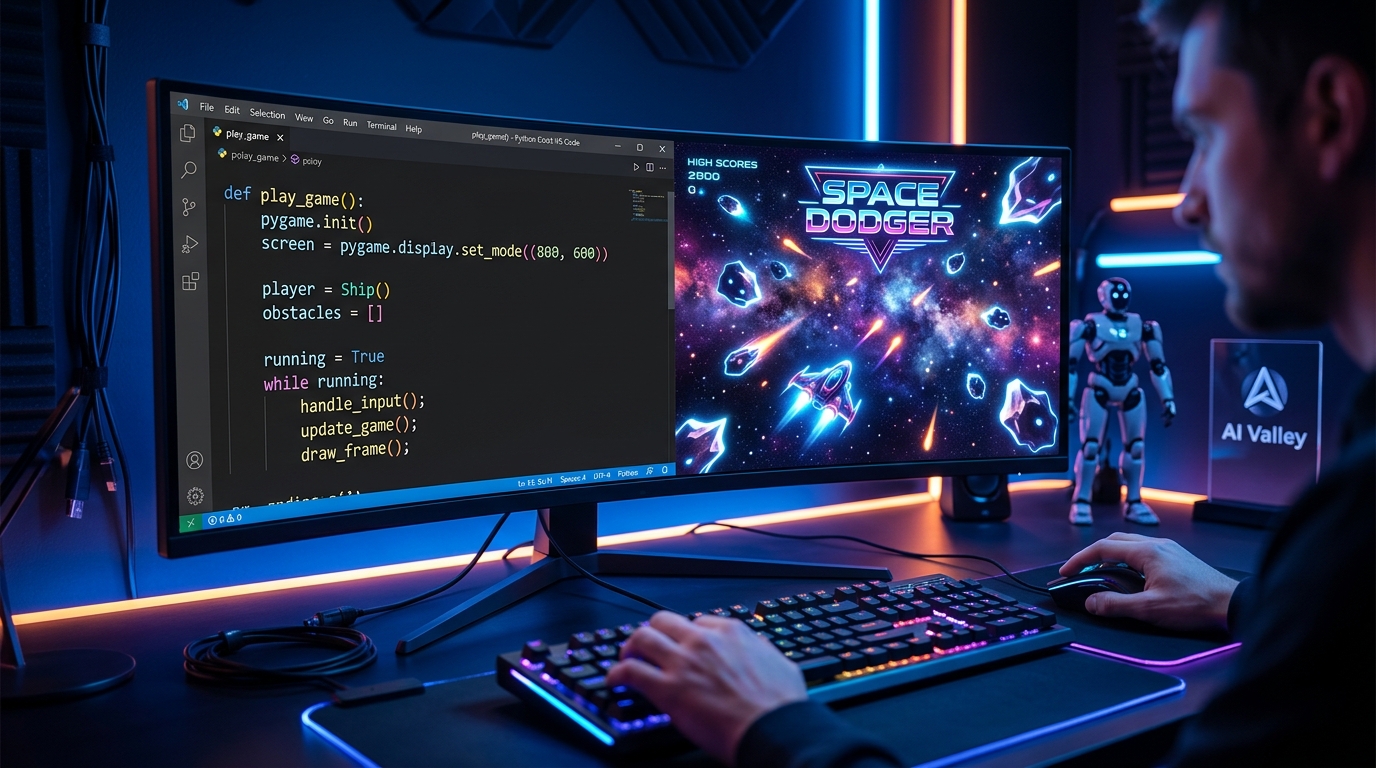
Build an Interactive Space Dodger Game: A Hands-On Python Tutorial from AI Valley
Welcome, future game developers! As a senior technical instructor at AI Valley—the premier institute driving STEM education across the Tricity area—I see students transform from complete beginners into confident creators. At our flagship lab in Zirakpur, students build dynamic projects just like this one every week to master core programming concepts. Today, we are going to dive into the exciting world of game development by creating an interactive 'Space Dodger' game using Python and Pygame.
Whether you are a young tech enthusiast diving into kids programming, or an adult looking to master Python, this tutorial is meticulously designed for you. By the end of this guide, you will have a working game and a much deeper understanding of how computer logic works.
🎯 What You'll Build
You will build a fully functional arcade-style survival game where the player controls a spaceship dodging incoming asteroid fields. The game features real-time keyboard controls, randomized enemy generation, collision detection physics, and a live scoring system. This is exactly the kind of project our students build during their weekend coding classes to master Python logic and Object-Oriented concepts.
📋 Prerequisites & Materials
Before we write our first line of code, let's make sure your development environment is ready.
- Python 3.8+: Installed on your computer.
- Pygame Library: We will use this dedicated game development module. It provides excellent pre-built functions for drawing graphics and handling sound.
- Code Editor: VS Code, PyCharm, or Python IDLE.
- Keyboard & Mouse: For testing your game controls.
- Note: If you don't have a PC setup yet, visit AI Valley's Zirakpur lab where all materials and high-end workstations are provided for our students!
To install Pygame, open your terminal or command prompt and run:
---
Step 1: Setting up the Game Engine and Canvas
Every great game starts with a blank canvas. In this first step, we will import our necessary libraries, initialize the Pygame engine, and set up our display window. Think of this as building the theater where our play will take place.
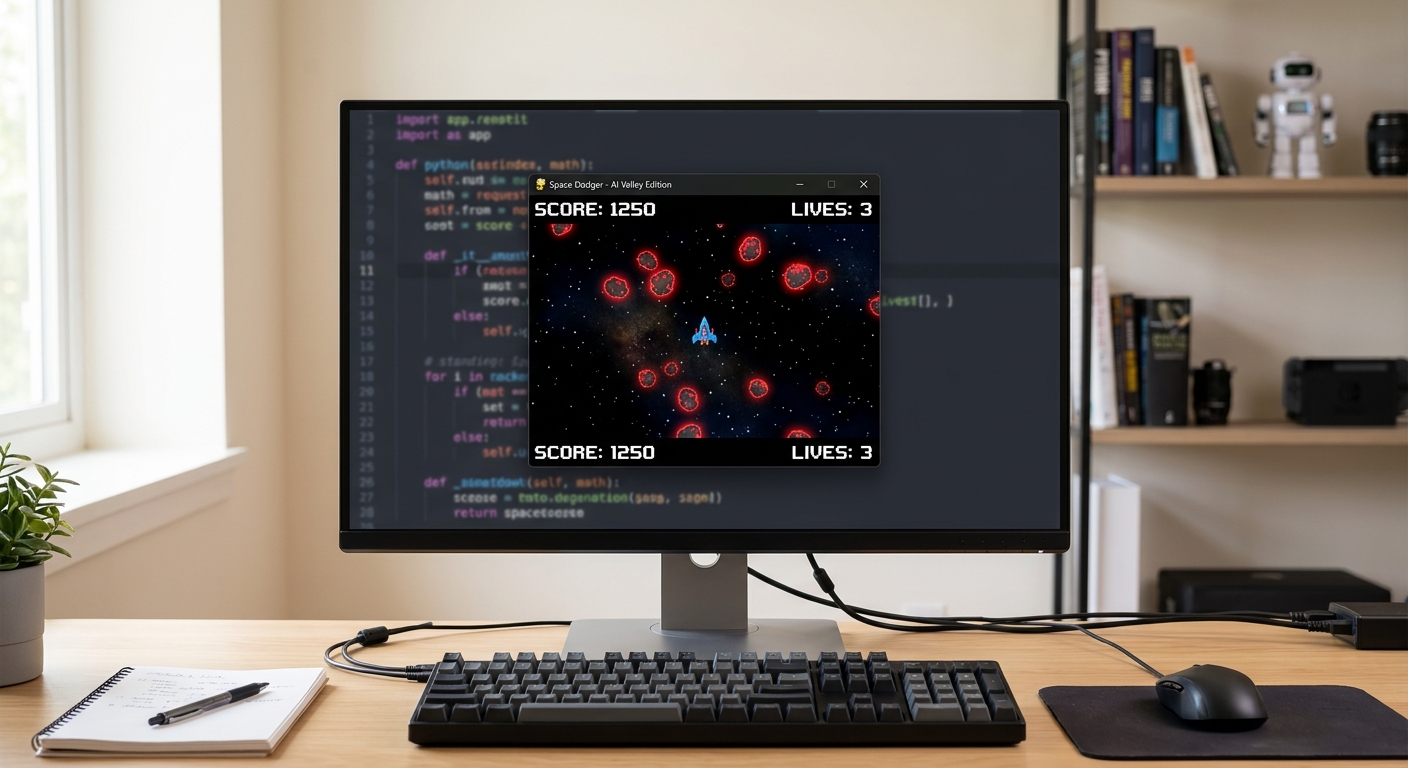
A computer screen showing a black Pygame window titled 'Space Dodger - AI Valley Edition' with code visible in the background.
💡 Understanding the Code
We importpygame to handle graphics, random to spawn asteroids unpredictably, and sys to securely close the game. The pygame.init() command turns on all the internal game engine gears. We then define a window size of 800x600 pixels.A Quick Note on Pygame Coordinates: Unlike standard math graphs where (0,0) is in the bottom-left, computer graphics place (0,0) at the top-left of the screen. As the Y-value increases, objects move down the screen.
Step 2: Forging the Player's Spaceship
Now that we have a space (the black screen), we need a spaceship! Instead of relying on external image files—which can get messy to link—we are going to draw our ship dynamically using Pygame's built-in polygon drawing tools.
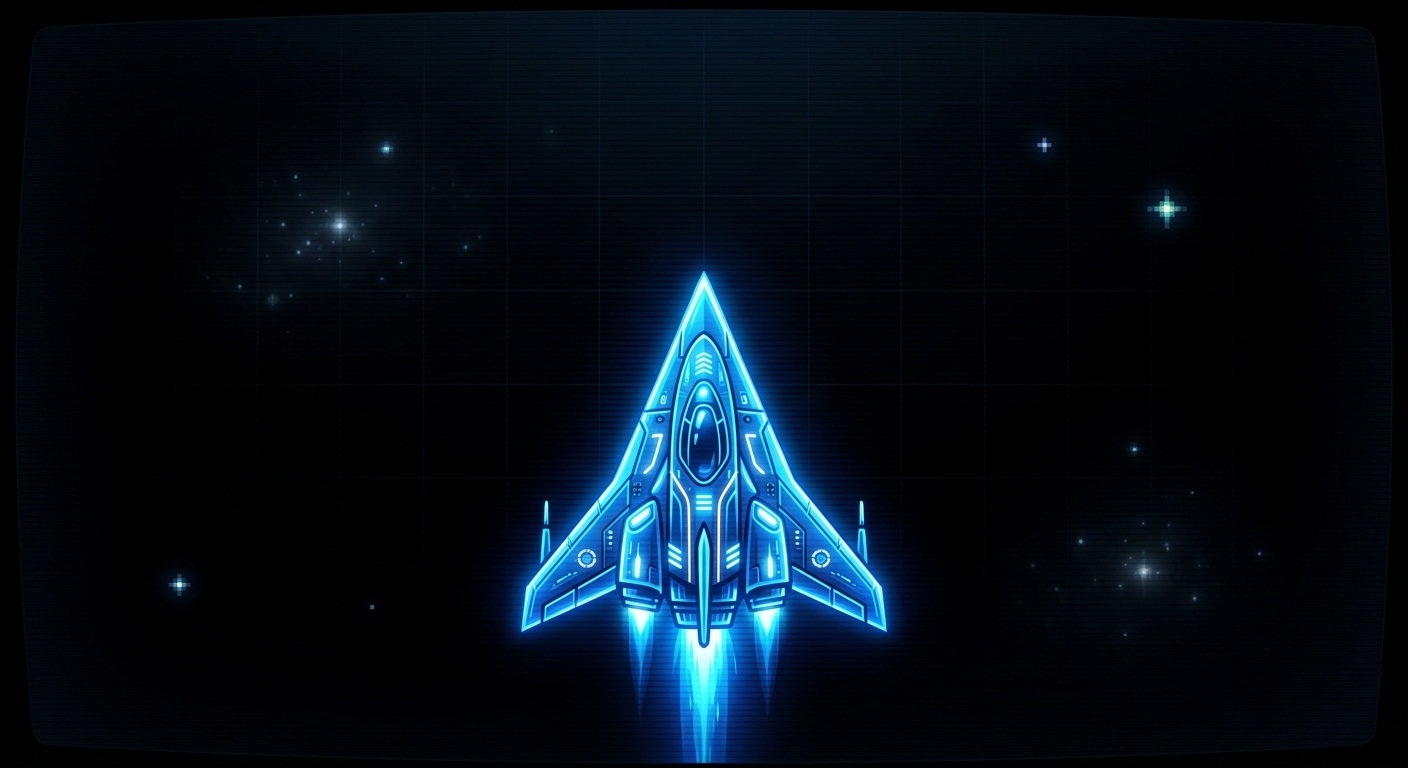
A bright blue triangular spaceship rendered at the bottom center of the black game screen.
💡 Understanding the Code
We define the player's size, starting coordinates (player_x, player_y), and movement speed. The draw_player function takes an X and Y coordinate and calculates three points to form a triangle. The pygame.draw.polygon() function then colors this triangle BLUE and stamps it onto our screen.Step 3: Spawning the Asteroid Enemies
A game isn't fun without a challenge! Let's write the logic to create falling red asteroids. If you're looking for the best coding classes for kids in Zirakpur, you'll know that we love teaching lists and loops through mechanics exactly like this.
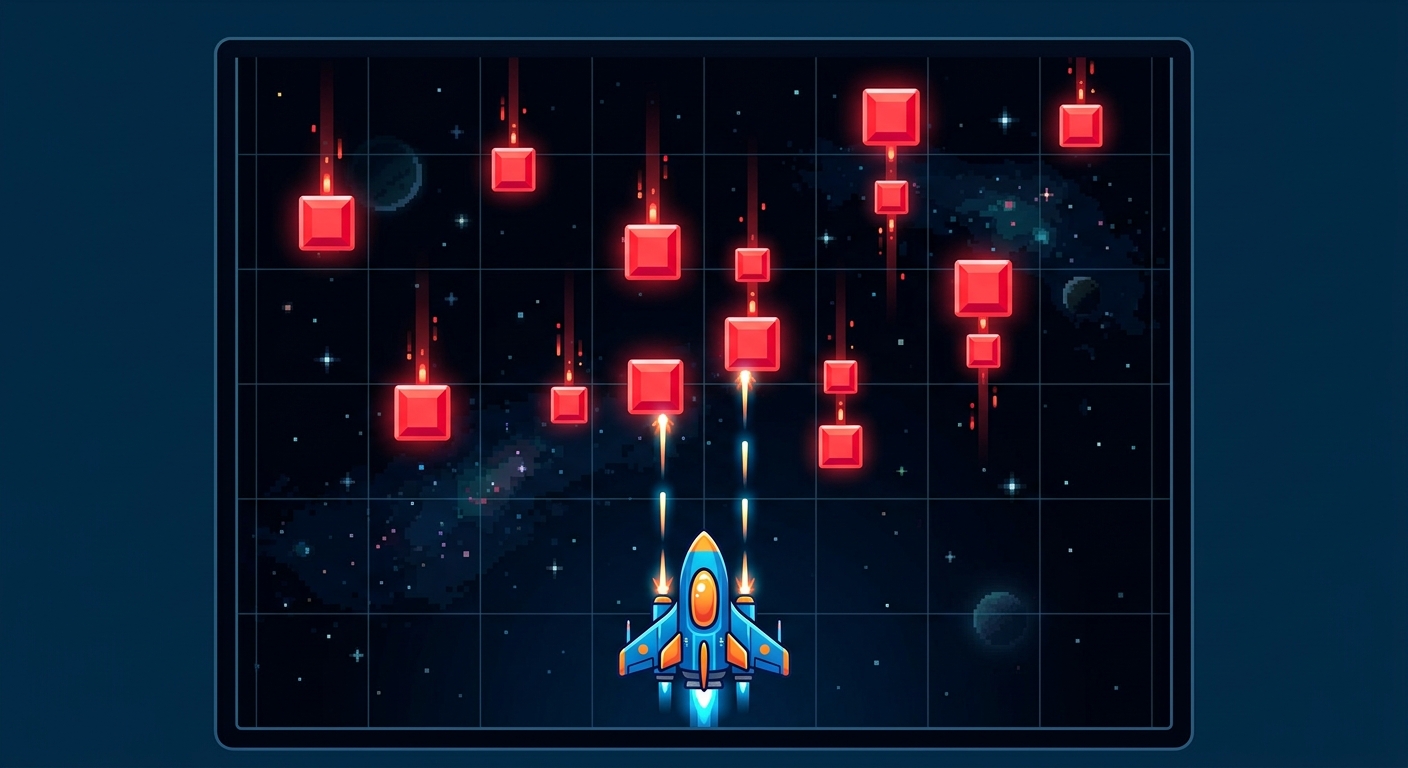
Red square asteroids of uniform size falling from the top edge of the screen downwards.
💡 Understanding the Code
We create an empty listenemy_list to track all active asteroids.
drop_enemies uses the random library to occasionally spawn a new asteroid. update_enemy_positions pushes each asteroid down the screen. Pro Tip from AI Valley: Notice how we loop through enemy_list[:] instead of just enemy_list? Modifying a list (like removing an asteroid) while looping through it is a classic beginner mistake that causes Python to skip items. Using [:] creates a safe temporary copy to loop over!
Step 4: Implementing Collision Detection
How does the computer know when your spaceship crashes into an asteroid? We use a technique called Axis-Aligned Bounding Boxes (AABB). We will draw invisible boxes around our spaceship and the asteroids and check if they overlap mathematically.
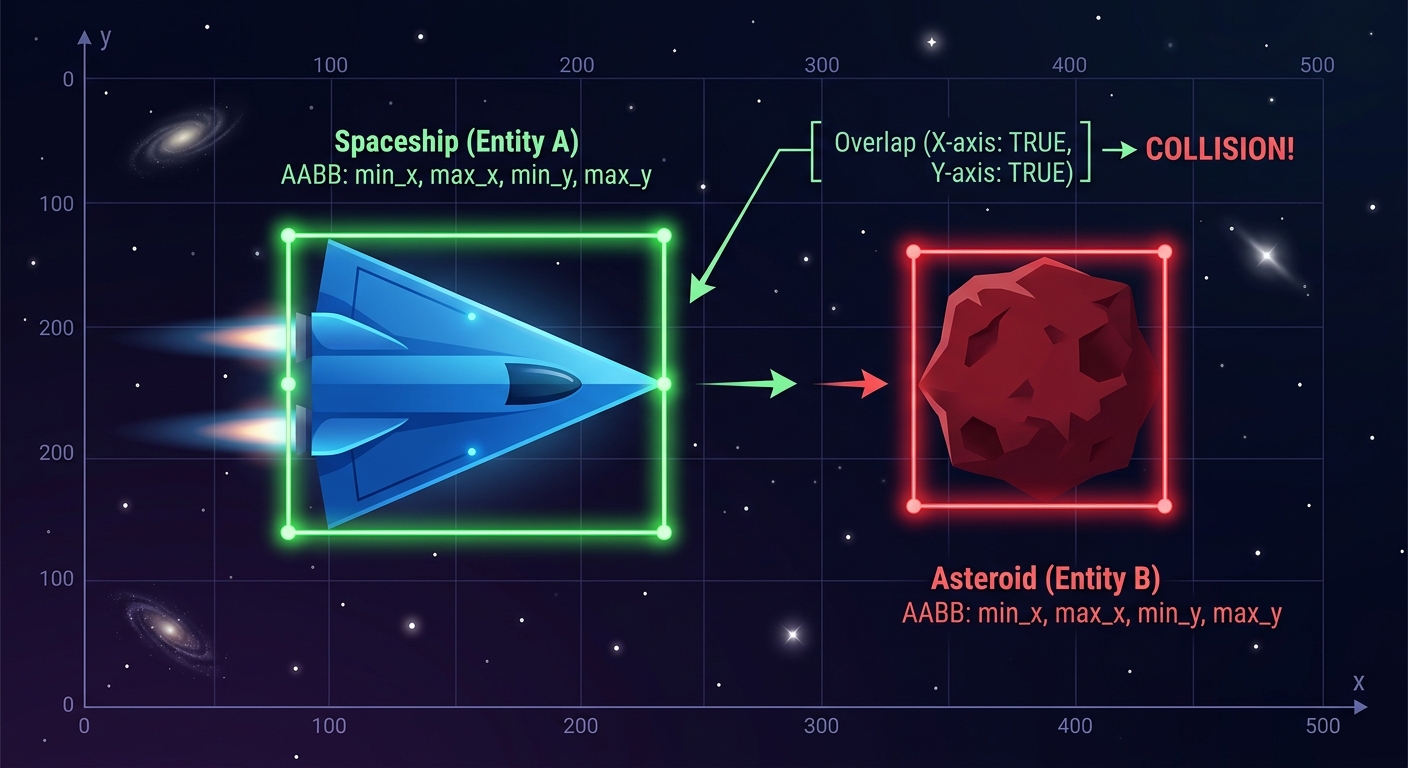
A visual diagram showing invisible rectangular bounding boxes overlapping between the blue spaceship and a red asteroid.
💡 Understanding the Code
pygame.Rect creates an invisible rectangle based on the object's X position, Y position, width, and height. If the player's rectangle and any enemy's rectangle touch, colliderect() triggers and the function returns True (meaning a crash happened).Step 5: The Main Game Loop & Keyboard Controls
Now, we bring everything together. The "Game Loop" is the beating heart of your program. It continuously checks for user inputs, updates physics, and redraws the graphics 60 times a second. Students seeking the best Python training in Chandigarh and Mohali often spend hours perfecting game loops just like this!
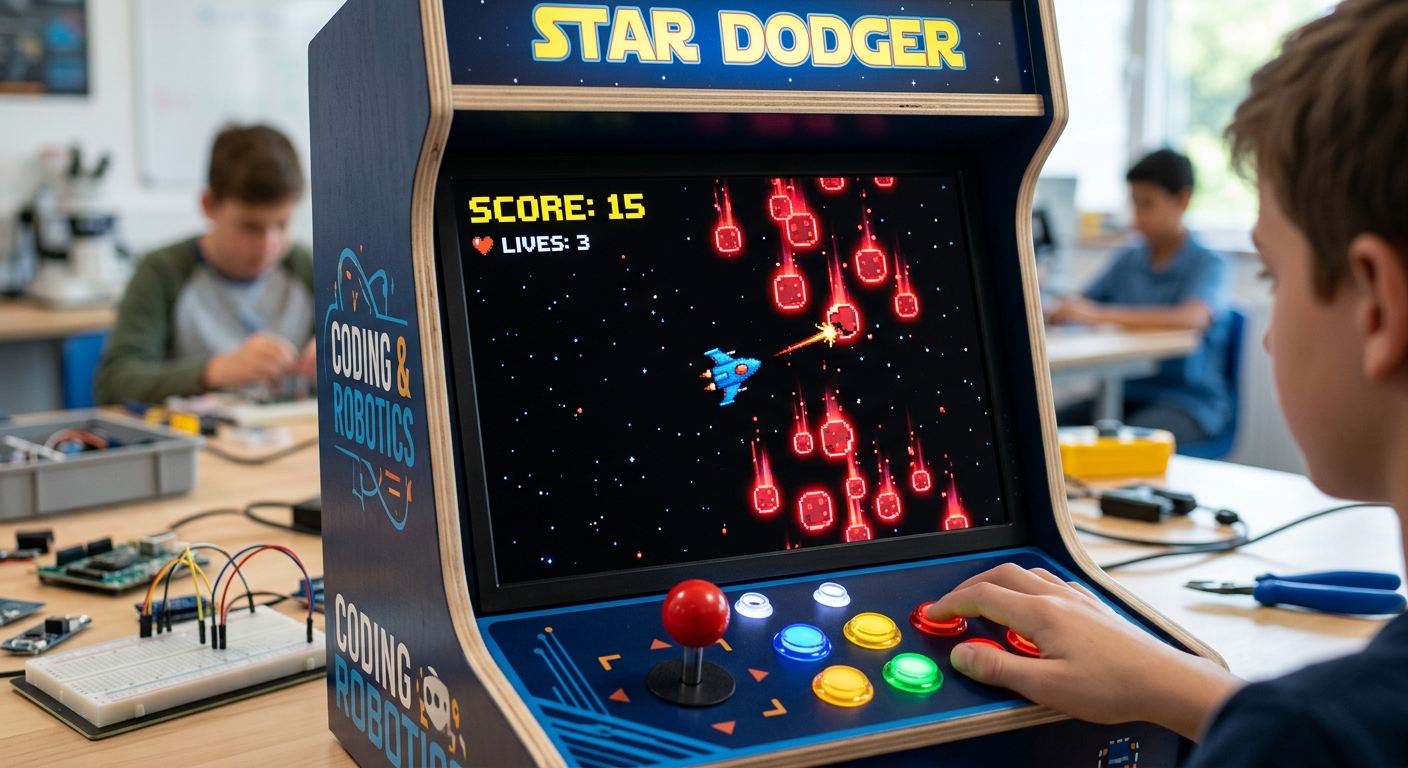
The complete game running, showing the blue spaceship moving left while dodging red asteroids, with a yellow score '15' in the corner.
💡 Understanding the Code
Thiswhile loop runs continuously. It checks if you pressed the "X" to close the window. It detects the Left and Right arrow keys, modifying player_x to move the ship, while keeping it within screen boundaries (> 0 and < WIDTH).We then fill the screen black (to erase the previous frame), update enemy positions, check for collisions, draw the new frame, and update the score. The command clock.tick(FPS) ensures the game runs at exactly 60 frames per second on any computer, preventing it from running too fast on high-end gaming rigs!
Step 6: Handling the Game Over Sequence
Abruptly closing the game when you crash isn't very user-friendly. Let's add a dramatic "Game Over" screen that shows the player their final score before the game exits.
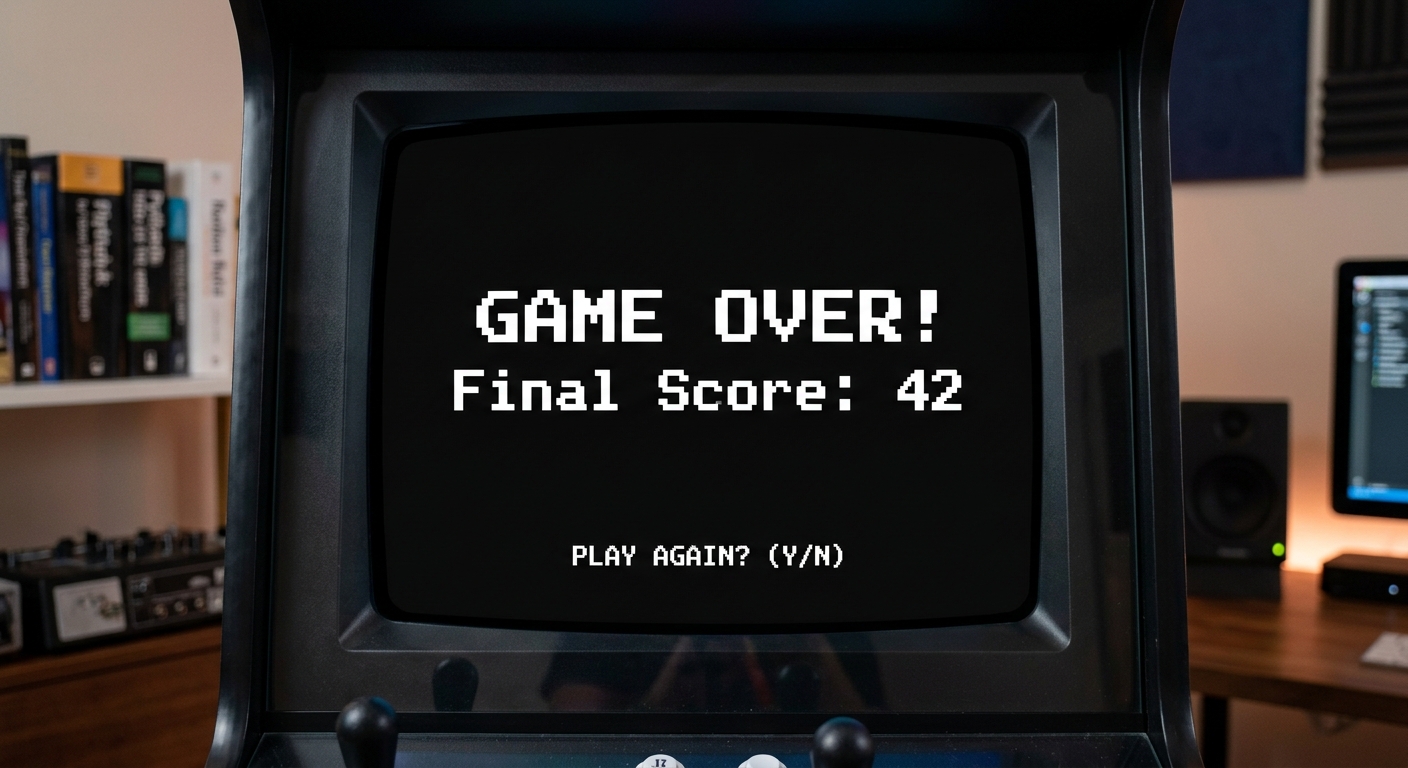
A dramatic stark Game Over screen with white text displaying 'GAME OVER! Final Score: 42' centered on a black background.
📜 The Complete Code Put Together
If you got lost during any of the steps, don't worry! Here is the complete, fully assembled source code for your Space Dodger game. Simply copy and paste this into a file named space_dodger.py and run it:
Click to view the complete Space Dodger Code
🎉 Final Result & Next Steps
Congratulations! You have just built a complete, interactive arcade game from scratch using Python. You've mastered coordinate systems, event handling, game loops, collision mathematics, and object movement. These are the exact same fundamental principles used by professional software engineers and game developers!
🚀 Challenge: Take It Further
Ready to level up? Try adding these features:pygame.mixer.Sound to add laser sounds or crash explosions.🏫 Start Your Tech Journey at AI Valley
Building games is an incredible introduction to your coding journey. AI Valley is proud to be the top-rated destination for tech education, serving brilliant minds across Chandigarh, Mohali, Panchkula, and our home base in Zirakpur.
Our comprehensive curriculum covers everything from beginner logic to advanced AI and Python development. Whether you are looking for engaging after-school programs for your children or professional upskilling for yourself, we provide the ultimate learning ecosystem across the entire Tricity region.
Ready to transform screen time into creation time? Visit aivalley.co.in or drop by our state-of-the-art lab to Enroll at AI Valley today, and let's build the future together!